
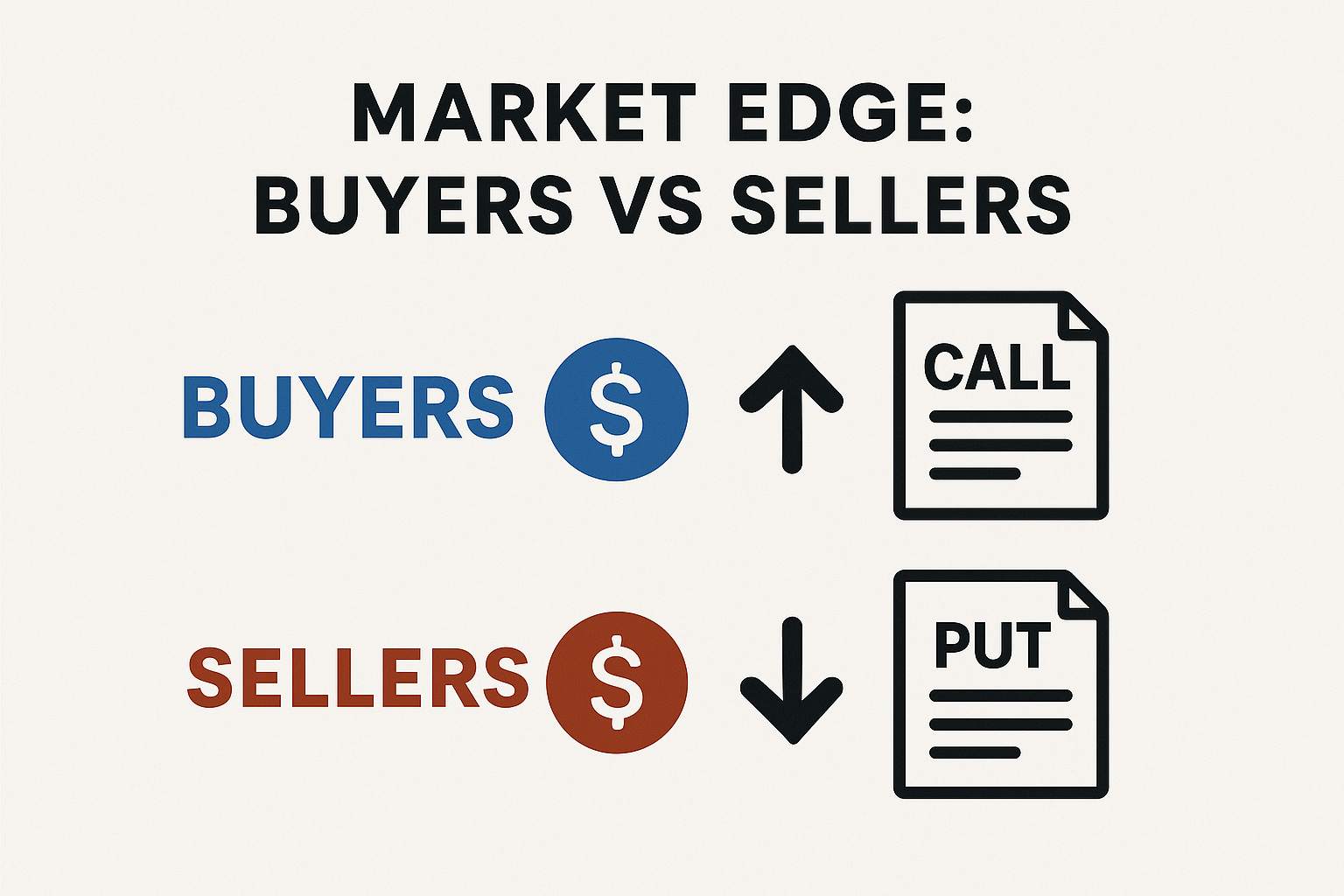
Traders often ask: “Is there an edge for buyers vs. sellers?” Especially in options, it feels like sellers have a built-in advantage. θ (theta) decay works against buyers, time works in favor of sellers. Yet buyers sometimes win big, recoup losses, even dominate for stretches. How does it all balance? And is there really an edge if everyone tries the same thing? What role does risk management and psychology play?
Below I explore these questions:
- Options sellers & theta decay: mathematical edge?
- The zero-sum nature of derivatives, but non-zero sum for long term investing
- Why winners often suffer many small losses (or frequent losing trades) and occasional big wins
- Why many good strategies fail in practice: early abandonment, emotions, poor risk control
- What gives a real edge: System, discipline, risk rules
1. Options Sellers & Theta Decay: Is the Edge Real?
Theta is the rate at which an option’s time value decays, all else equal (i.e. underlying price, volatility, interest rates held constant). Investopedia
- For option buyers, theta is usually negative. As time passes, an option loses extrinsic value, meaning that even if the underlying does nothing, the option will lose value. This works against the buyer. Option Alpha
- For option sellers (writers), theta is positive. Time is their ally. If the underlying remains range-bound, or moves slowly and not too far, the seller can collect premium and profit from decay. Merrill Edge
So yes — mathematically, in pure time decay terms, sellers have an edge. But — and this is big — this edge is neither guaranteed nor risk-free.
Risks for Sellers
- Large adverse moves: a sudden move in underlying price (or implied volatility spike) can wipe out premium and then some. Sometimes losses are unbounded (for example, short naked calls) or very large relative to premium collected.
- Volatility & implied vol mispricing: If implied volatility is low, premium might be cheap; if you sell in overheated implied vol environments, risk of reversion or spikes is high.
- Assignment risk, liquidity issues, slippage, transaction costs: especially for more complex or short-dated options.
- Tail events: rare but extreme moves can kill many small profits and one large loss wipes them out.
So the edge for sellers is real when probabilities, risk, and sizing are managed well. It’s not enough to “just sell everything” and expect profits.
2. Zero-Sum Games & Long Term vs Short Term
The derivatives markets (options, futures, etc.) are often zero-sum games: one party’s gain is another’s loss. Environmental Trading Edge+4Investopedia+4Quantified Strategies+4
- Every option contract has a buyer and seller; if the buyer wins (underlying moves favorably + other Greeks + implied vol), the seller loses, and vice versa. Quantified Strategies+2Investopedia+2
- Also, when transaction costs, slippage, and volatility mis-prediction are included, many trades may become a negative-sum game (i.e. more money lost by participants than gained overall, because part of the “transfer” goes to costs) Quantified Strategies+1
However, when thinking about long-term investing (equities, dividends, economic growth), the market is not strictly zero sum. Wealth is created by companies, innovation, productivity. For example:
- Stocks tend to drift upward over decades (earnings growth, inflation, reinvestment, dividends)
- Investors receive returns not just from price
Even in trading, though, many “long term investors” behave differently than short-term derivative speculators.
3. The Risk-Reward Tradeoff & Win Rates vs Payoff Ratios
A lot of what causes the tension in your thinking arises from asymmetric reward: buyers might lose often, but occasionally win very big (“home runs”), whereas sellers might win more often but in many cases with limited upside relative to downside.
- A buyer of delta-long options may lose (expire worthless) many times before one big move yields a large payoff.
- Sellers collect small premiums often, but risk large losses when the trade goes against them.
This means:
- Win rate can be very different from profitability. High win rate + small average win / large occasional loss can be worse than lower win rate + big wins + small losses.
- If a buyer’s payoff is large enough on winning trades, it can recoup many losing trades. But risk of ruin (or large drawdown) is higher.
This dynamic is often built into “tail risk” strategies, or big-payoff options bets (deep out-of-money options, long straddles around expected events, etc.).
4. Why Many Strategies Fail: Not Because the Edge Doesn’t Exist, But Because of Implementation & Psychology
Even when someone builds a strategy with favorable backtests or theory, many fail in live trading. Here are some common pitfalls:
| Fail Point | Description |
|---|---|
| Abandonment after early losses | A strategy might have drawdowns, losing streaks. The trader gets shaken out before the strategy shows its full potential. |
| Exiting winners too early | Fear of losing profits causes premature exits; “lock in gain” mentality can reduce payoff ratio. |
| Holding losers too long | Hope that “it will turn” kicks in, leading to letting losses run, increasing drawdown. |
| Poor risk management / position sizing | Even a good edge fails if risk per trade is too big, or if a single loss or cluster of losses depletes too much capital. |
| Overfitting / curve fitting | Backtests that look great in past data but rely on coincidences, data quirks, or lack robustness. |
| Ignoring regime shifts (market environment changes) | What works in low volatility, trending or mean-reverting markets may break in high volatility / crisis / structural change. |
Psychologically, watching trades every day, being over-exposed, caring too much about each losing trade — these add costs (both monetary and emotional) that aren’t in the backtest.
5. What Gives a Real Edge: System + Risk + Discipline
This is where my own trading journey comes in. Back in July 2025, I started my 1000 Days Challenge — a commitment to follow a systematic approach with risk management every single trading day for nearly three years.
Why? Because I realized that without rules, even the best backtest or “edge” crumbles under real emotions. With a system in place:
- Losses are capped (exits at predefined thresholds like 70% loss or 50% profit).
- Position sizing avoids catastrophic drawdowns.
- Strategies are given room to play out through winning and losing streaks.
The challenge is my way of enforcing discipline, resisting the temptation to abandon strategies prematurely, and building consistency over time.
6. So, Who Has the Edge?
Summing up all this, the answer is:
- In options & derivatives, sellers have a mathematical advantage due to theta decay, provided risk is managed well.
- But this advantage is fragile in live markets: big adverse events, volatility, regime changes, leverage, and psychological biases can quickly ruin it.
- For buyers, the edge is lower probability events but high payoff; success depends on sizing, picking favorable risk/reward, avoiding paying too much premium, and being disciplined.
- In pure naked buying or selling (without risk limits, without systematic approach), it’s unlikely to consistently win. Because losses of buyers or sellers will accumulate unless they bring structure.
- The real edge comes when a trader or system can combine good strategy (backtested, robust), proper risk/rule discipline, patience, and the ability to persist through drawdowns.
7. Conclusion
- Yes — there can be an edge for both buyers and sellers, but they succeed in different ways.
- Sellers benefit from time decay; buyers benefit from asymmetric large wins. Neither is guaranteed.
- The zero-sum concept reminds us that for every winner there’s a loser (in derivatives), but over long term, with growth and dividends, markets are not purely zero sum.
- The biggest inhibitors are behavioral: improper risk, fear, greed, abandoning good strategies, emotional overtrading.
- The key is structure: developing a systematic approach, managing risk, having rules for trade entry, exit, sizing, accepting that drawdowns are part of the journey, and being disciplined enough to ride through them.
👉 By framing the market as a battleground of buyers and sellers, and tying it back to my own journey in the 1000 Days Challenge, I want to show that the real edge doesn’t come from being a buyer or a seller — it comes from the system behind the trades, the risk management rules, and the discipline to follow them through.