
Every trader knows the feeling —
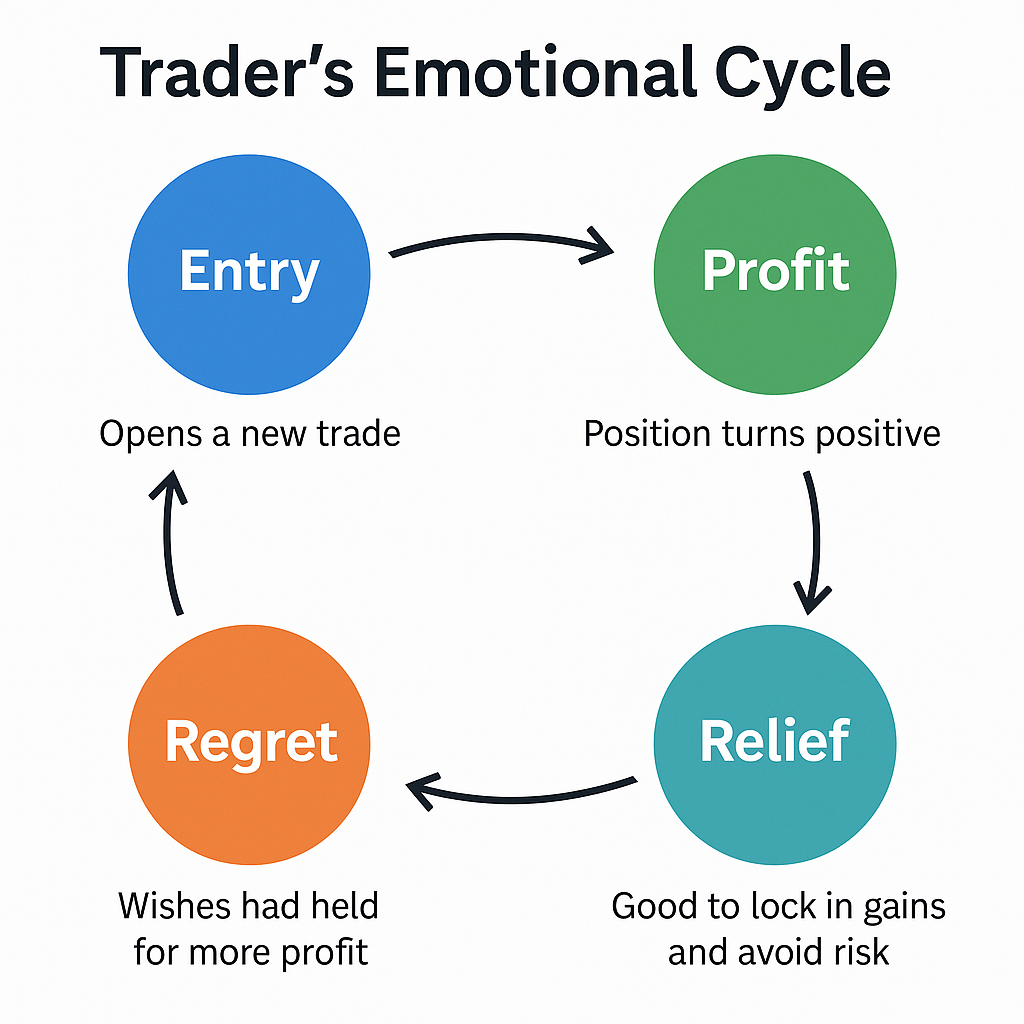
You execute your plan, the trade turns green, and that familiar voice whispers:
“Take the profit. You’ve done enough. Don’t risk it overnight.”
So you close the position.
Instant relief. Peace of mind.
You check your account and see a +2% or +3% gain.
But when the market opens flat the next morning, you look at the option chain and realize…
the same position would have gained another 5% or 6% from theta decay.
You didn’t lose money — but you still feel like you lost.
Why does this happen? And what can we do about it?
🎢 The Emotional Cycle Behind “Safe Profits”
This behavior — taking quick profits to avoid overnight risk — is surprisingly common, and psychology has clear explanations for it.
1. Loss Aversion (Kahneman & Tversky, 1979)
Humans feel the pain of a loss twice as strongly as the pleasure of a gain.
When you’re up 2%, the mind doesn’t think about maximizing reward — it thinks about protecting that gain.
The relief of locking in profit is neurologically similar to escaping danger.
Your brain literally releases dopamine when you “avoid a potential loss,”
even if holding would statistically lead to higher returns.
2. Regret Aversion
Traders unconsciously minimize future regret.
If you hold overnight and the market gaps down, you’ll feel you “should have exited.”
So your brain pre-emptively protects you from that emotional pain — by forcing an early exit.
But the irony is that you then face a different kind of regret — the regret of leaving money on the table.
You “win,” but your emotional state says otherwise.
3. Variable Reinforcement (The Casino Effect)
Booking quick wins creates a reinforcement loop — the brain starts to crave that small, frequent dopamine spike.
Like a slot machine that rewards random wins, your trading becomes subconsciously wired to “lock in green” even when your strategy calls for patience.
This short-term satisfaction gradually erodes long-term expectancy.
🧮 Why It Hurts More for Calendar Traders
For strategies like Double Calendars (DCs), where theta decay compounds overnight, early exits are particularly costly.
The structure’s edge lies in time, not immediacy.
When you close too early:
- You cut off the theta component before it can mature.
- You also reduce sample size — missing the chance to test your strategy’s statistical edge over time.
So even though the outcome was profitable, you’ve traded away your system’s advantage for emotional comfort.
📚 Research-Backed Insights
- Neuroeconomics studies (Knutson et al., Neuron, 2008) show that traders’ brain scans light up the same reward centers whether they book a profit or avoid a loss.
→ Meaning: the “relief” of being out of a trade feels just as good as an actual win — temporarily. - Behavioral finance research finds that premature profit-taking is among the top biases that reduce long-term performance, even for professionals.
(Odean, 1998 — The Disposition Effect) - Cognitive dissonance plays a role too — we rationalize early exits by saying,
“At least I made money,”
instead of admitting,
“I didn’t follow my edge.”
🧘 How to Improve Your Trading Psychology
Here are strategies I’m personally working on to train my decision-making to align with my system — not my emotions:
1. Pre-Commit Rules Before Entry
Write down your exit criteria before the trade is live.
If your plan says “exit only if delta > 0.7 or end-of-day,”
you must treat that as law — not as an emotional suggestion.
2. Use a “Temptation Log”
Each time you want to close early, write:
“What am I feeling right now?”
Over time, you’ll spot emotional triggers — fear, greed, boredom — and begin to detach from them.
3. Trust the Law of Large Numbers
A single trade doesn’t define your edge.
The series of 100+ trades does.
If you cut short 40% of your setups, the math of your system breaks.
4. Reframe “Risk”
Holding overnight feels risky, but so does not allowing theta to work.
Avoiding theoretical loss can be just as harmful as taking one.
5. Automate Partial Decisions
For systematic traders, automation removes emotion from the equation.
Let your software manage exits based on your predefined deltas, time decay, or P/L thresholds.
Automation doesn’t just save time — it saves you from yourself.
💭 Final Reflection
This journey taught me that discipline is not just about following a strategy — it’s about mastering yourself.
The market punishes emotional traders, not because they’re wrong,
but because they exit too soon when they’re right.
“If you win and still feel like you lost, that’s your psychology asking to be trained — not your system asking to be changed.”
Next time I close a trade early, I’ll ask myself:
Was it logic or fear that made the decision?
⚠️ Disclaimer
This post reflects my personal trading experience and opinions.
It is intended for educational and self-reflective purposes only and does not constitute financial advice.
Options and derivatives trading involve substantial risk and may not be suitable for all investors.